

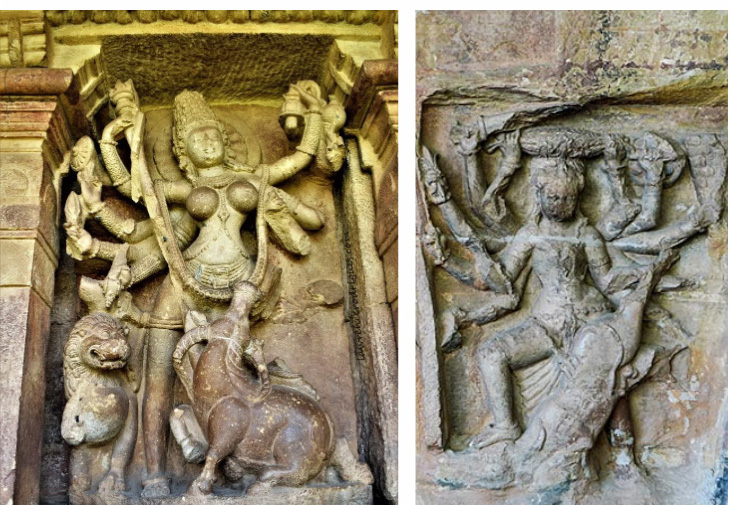
On observing the images displayed (scroll down), one can see:
- the subject presented is the same ie Mahishasuramardhini
- the geography where the subject is represented is however different, and
- the chronology, is spaced out at least by a century
But what is so fascinating about the subject that the sculptors across geography and time have indulged in the same subject?
To simply put, the answer is: the indulgence in the idea of good over evil is where the ultimate intelligence is hidden. It is here that the unbound imaginative space begins, and reflective thoughts originate. The artist while indulging in the subject, experience an inexplainable joy of that allows them to declutter, segregate and sort the black and the white from the greys within themselves, thereby helping one to see Reality as it is. Thus, the subject became a continuous discourse for the Indian artists showing timelessness, with a classical character that could be expressed infinitely.
The subject allowed the artists to experience at the highest level of beauty, giving them room to attempt the impossible: fitting a square into a circle. Their attempts did not go waste, and since their efforts were in the right direction, they were able to exact the Cosmic Nature. The chaos that mirrors in the human psyche are explored as forms and as virtues ideal for a society. Conveying their deep findings of the subject through an object as an ideal form by merely removing dirt from the hard granite stones, they added layers of beauty onto themselves and the medium of art they were working on. In this way, they registered their imprint in Time and Space. They didn’t feel the need to sign their names, as they were confident that Time will honour their efforts, work, and life. Indeed the mediaeval Indian artisans have left behind a rich legacy, impossible to match even today.
Carefully choosing conjunctions where Nature was harmoniously resting; the artisans traced the scope of beauty back to Nature, and art was not separated from society, or accessible only to a niche or an intellect. Besides, during the mediaeval period, since the social and the political were tied together with culture as the holy knot, it allowed artists, connoisseurs and seekers to together explore human potential and intelligence, revelling in the moments of nothingness as forms. The artists never differentiated themselves from the connoisseurs and seekers as they wanted to engage with the society forever. Their collective thirst and intellectual grasp pushed the boundaries of imagination; allowing abstract ideas and traditions to get re-represented and re-created, carrying the civilisational continuity in many aspects of living. On visiting these destination, one will feel that they are living in these spaces and are still engaging through the ages with next,… next generations.
Unfortunately, this ability to appreciate the nuances in the elements of art and Nature is fading, as the world is getting increasingly fast paced; touched not by the warmth of knowledge, but gripped by statistics, data and information. The danger of the digital era is that everything is looked as black or white; when, Nature isn’t. Nature, in its full fury is shades of grey; and in its full glory is infinitely colourful. In knowing to appreciate true beauty, the knowledge of Nature can help the individual negotiate the greys inherent, processing his/her feelings better to handle the ups and downs of life experiences. On the other hand, in the lack of appreciation of Beauty, the inherent nature will turn too dark, with greys dominating the nature constantly, pushing the individual down through a vortex.
To sum up, art helps us to slow down our thoughts, streamlines our emotions and develops rational. It shapes our tastes and tendencies to simplicity. Appreciation for art will help us stop running in circles… giving us a directional sense to find the centre from where Beauty can be enjoyed forever. While theories of social justice, goodness ensure progress; theories of beauty develop the aesthetic sensibilities in an individual, growing their inward journey to acquire balance and stability.
To cultivate appreciation of art, The Beauty Path is conceived for a universal cultural identity to take precedence over multiple individual identities.